
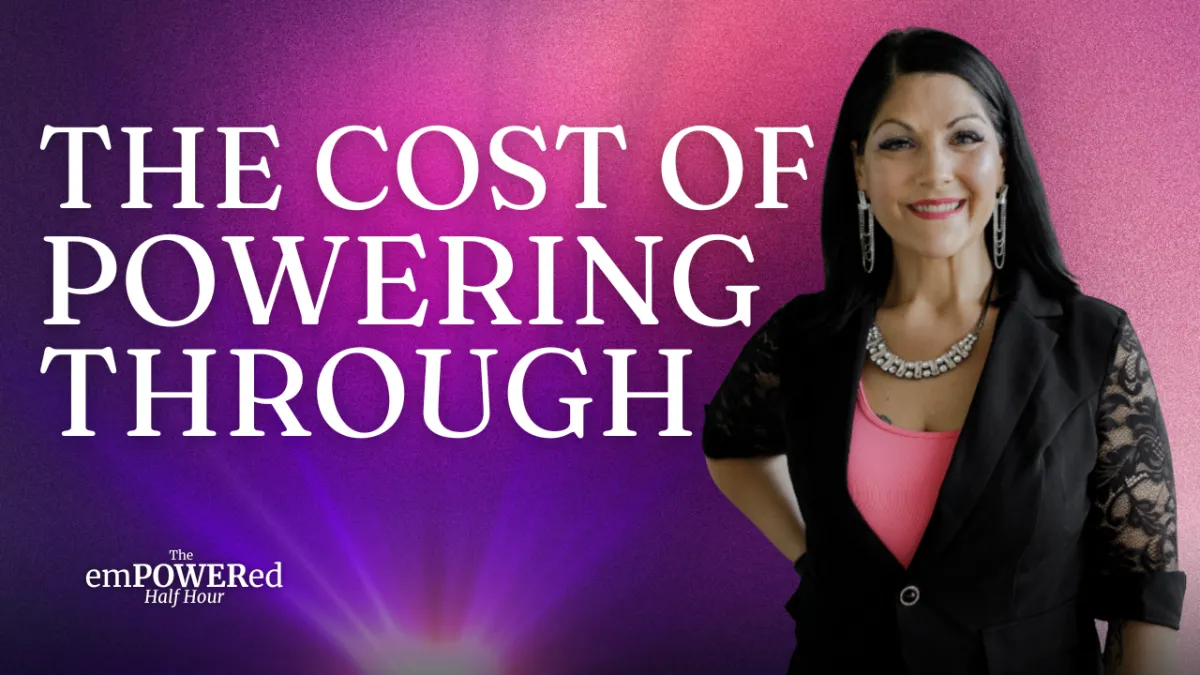
The Cost of Powering Through
In this milestone episode of The EmPOWERed Half Hour, Becca Powers is joined by Lynae Looney, Co-Founder and CXO of Powers Peak Potential to unpack one of the most important leadership conversations yet: why state always comes before strategy.
This episode explores why even the best leadership strategies fail when nervous systems are dysregulated. Becca and Lynae unpack how powering through leads to burnout, how stress shows up in the body, and why regulation and emotional safety are essential for sustainable leadership.
Through real world examples and lived experience, they reframe burnout as a nervous system issue, not a personal failure, and offer insights that can change how you lead, connect, and grow.
State before strategy
Why no amount of tactics work when someone is in survival mode
The cost of powering through
How chronic stress leads to burnout and physical breakdown
Leadership burnout
Why well-intentioned leaders become exhausted and frustrated
Stress in the body
How stress impacts mental, emotional, physical, spiritual, and financial wellbeing
Being over doing
Why leadership requires presence, not just performance
Feeling seen and heard
How regulation creates safety, creativity, and collaboration
Awareness as the starting point
Why noticing your state changes everything.
Key Moments You Won't Want to Miss:
Why leaders and teams burn out even when they are trying everything
How stress and powering through impact the body and nervous system
Why autoimmune disease and burnout are often linked to chronic stress
How being heard and seen shifts people out of survival mode
Why collaboration and innovation only happen in regulated states
How leadership changes when you pause instead of push
Empowering Thoughts to Take With You:
“Stress attacks your body. It attacks your mind, all of it.” – Lynae Looney
“When you start being kind to yourself and your nervous system, you can start healing yourself.” – Lynae Looney
“If you lead with good intentions but don’t consider where someone is, you can’t succeed at the level you need to.” – Lynae Looney
“When someone feels heard and seen, their survival mechanism gets shut down.” – Becca Powers
“You can’t out-strategize a nervous system.” – Becca Powers
Stay Connected
Take the Leadership Persona Quiz: https://beccapowers.com/takequiz
Subscribe to our weekly newsletter, The Regulated Leader: https://beccapowers.com/regulated
Join us in the TEHH Room, our podcast email list: https://beccapowers.com/empoweredhalfhouremailoptin
Website: https://beccapowers.com/
LinkedIn, Instagram, Facebook, YouTube: @Beccapowers1313
Subscribe and listen on your favorite platform: https://theempoweredhalfhour.buzzsprout.com
Follow Lynae Looney
Follow Becca Powers
🌟 Did you love this episode of The emPOWERed Half Hour Podcast? Sharing your thoughts can make a big impact!
💬 Leaving a review is simple:
Scroll down to the "Ratings & Reviews" section.
Tap "Write a Review" to share your thoughts and let others know what you loved about the show.
Your feedback helps us grow and continue delivering the content you love. Thank you for being part of our empowered community! 💖
We Want to Hear From You!
Where in your life or leadership are you powering through instead of pausing? Have you noticed how stress is showing up in your body or behavior? What would change if you checked your state before taking action or giving feedback?
Share your biggest takeaway and let us know how this episode is shaping the way you lead, listen, and show up.
Becca Powers: Welcome to another episode of the Empowered Half Hour. And you guys, it's the hundredth episode. You are listening to the hundredth episode. Can you believe it? Three digits, baby. We've made it. And I am joined today by my business partner, co-facilitator of all of our programs here at Powers Peak Potential, and one of my best friends.
Yay. Let me introduce you, reintroduce you, 'cause she's been here before. But Lynae, welcome to the show.
Lynae Looney: Thanks for having me. I appreciate it. Hello everybody.
Becca Powers: Yes. And you guys, you're gonna see a lot more of Lynae this year because we are out in the world. We are training, we are coaching, we are out doing things, and we have thoughts to share.
So in this episode being number 100, we wanted to bring to you a topic that is hot off the press. So today's topic is gonna be state before strategy. It's one of our principles from the seven principles of Trauma-informed Leadership, which if you're deep in our world, you're aware of, if you're just surface level in our world, you may not have heard of that before.
So we have a thing that we do. We run a webinar once a month, once every other month. Pay attention to the website and all social media and all that. You'll see when these events are, if you wanna see it. But we do an event called Trauma Informed Leadership Live. And during the recording of this, so not the release of this episode, but during the recording of this episode, we just came off the coattails of that live and Lynae, what was your overall like gut feeling coming out of that? How'd you feel?
Lynae Looney: I felt great. I thought we were hitting all of the things that these leaders came in to hear and that they needed to hear. It was a great event. So if you missed this one, join us for our next one.
Becca Powers: Yes. And it was so cool because leaders need a support group, kind of like if you're in AA or some type of other support group. What I've learned is that leaders need a support group too. And what was really great about this webinar is that we talked about the 10 leadership issues that we see most.
And the resonance was incredible. People were like, yeah, that's me. From the chronic, over to the mission-driven burnout to toxic leadership, we kind of go into it all. But one of the principles, as I was mentioning, it's principle two, is state before strategy. What I found completely wild is that we talk about a breach to leadership like security has breaches to its data, right?
And if you have these two bad actors, one is strategy-first leadership, and the other one is performance tools before biology type of thing. Get hacked. And once you get hacked and your people go into burnout, you go into burnout, results start slipping, and then we see the big monster dysregulation.
I always kind of mess that up, but dysregulation. Okay. I had to joke around for a minute, but I say all that to say that we repeated over and over again that strategy-first leadership was one of the breaches that causes all this stuff. And what was really wild to see is that we experienced that live on day three.
So, Lynae, I'm gonna pass it to you, but I wanted to ask. What was your takeaway on day three when we saw a whole bunch of leaders asking questions on how to handle situations when that was one of our teachings during the three-day process?
Why You Can’t Out-Stratagize a Nervous System
Lynae Looney: Well, it turned out to be exactly that. We saw the problem right there because everyone's coming to the floor with, "Hey, I have this problem, and here's the scene right here. I need a quick fix or give me a one-shot answer to fix this big problem." And it was all about strategy. They weren't even thinking about the state. They were definitely just like, strategy, strategy, strategy.
And we're like, were you listening the past couple days? Because that is not the way to go about it. That's not gonna get you the result that you're looking for. And there's absolutely no quick answers or quick fixes to any of these problems. So we saw that in live time. That's one of the issues leaders are facing. They're always thinking about, I just need a strategy.
Becca Powers: Right. That is absolutely right. And one of the reasons that the strategy doesn't work, and what we taught about in that is that you have to apply state before strategy. And so what do we mean when we talk state before strategy? Well, I think the basic thing is that you can't out strategize a nervous system.
Lynae Looney: Mm-hmm.
Becca Powers: And so I'm gonna give that back to you, like, just to comment off of. I think that was a huge aha that did come up during the live event.
Lynae Looney: Yeah. Because when you say it like that and you explain more around it, it just makes sense. You can't strategize your way out of it. If I say this one thing, it's going to fix that person's state. It's going to change everything. It's absolutely not. So it's very interesting to see how everybody's approach is very much the same. No one's considering the person and the state that they're in and approaching it from that way before they're going into a strategy to deal. So it then ends up being a miss.
Becca Powers: It does. And I think we might need to give the audience some more color. And I want to throw this to you, but I know you're gonna enjoy talking about it. Lynae, I think you will. Can you tell them about the bear?
Lynae Looney: The bear? Well. It's that scene, right when you're walking through the woods and you're feeling the sun on your face and you're just in this tranquil state and you're feeling good, and then all of a sudden you hear something, you hear a little rustle.
And then all of a sudden you turn around and no, there's a bear. It completely changes your whole state. It went from calm, cool, collected to panic freeze. Getting leaders to understand that they're the bear in the scene with their employees, in an office situation, you're the bear.
You send them an email, "Hey, I need to talk to you." Very innocent, right? And it might be, but all of a sudden you're the bear. They're like, what's going on? What did I do? Am I in trouble? They're overthinking everything. It instantly puts them into a completely different state. Even though your intentions might have been completely innocent or good, you become the bear.
Start an instant meeting. How are they gonna react? They're gonna be frozen. They're gonna be defensive. I don't know which way they're gonna react, but you're the bear.
Becca Powers: Wow. I just like, I love when we talk about the bear, but just hearing you talk about it, I'm like, it's true. As leaders we're the bear and that, my friends, my fellow listeners is the truth. Because we have good intentions as leaders, as parents, as whatever leadership role we're playing. But as soon as we approach someone, and it might feel in any way shape or form corrective, the nervous system is gonna go into what we refer to as the four F's or the survival states.
So it's not like I coined it the four F's, but that's what I like to call it: flight, fight, freeze, or fawn. And what we spend a lot of time talking to leaders about is that if you really slow down to recognize these patterns, these states, you're gonna notice that you're not going to be effective.
Because let me just give you an example. Like Lynae is my boss. She comes up to me and I say, "Becca, I need to talk to you." And I'm like, oh no, what is this gonna be about? I'm just kidding. We have great meetings. But I could be going into there, like, I'm not sure what we're gonna talk about today, and just feel a little nervous, even though we're great.
And then she says something like, "Hey, we really need to work on your keynotes and removing language and okays." And I guess because she's my boss, she tells me what I need to do. And then all of a sudden I'm freezing because I'm like, oh my God, I have to take this feedback. I know it's gonna make me better. And then she realizes that I am no longer in a state to receive feedback because I am frozen.
Why Traditional Leadership Training Fails Without Nervous System Regulation
Lynae Looney: Yeah.
Becca Powers: And I'm panicking. So we use humor to regulate ourselves, but I'm using this silly example, which has happened in real life, to show that even in the most strong relationships where there's a lot of trust built, depending on the topic even, you could go into a survival state.
And if I'm in a freeze state and we need to work on big business things, it is not gonna work. She can use all the strategy in the world and all the tactics in the world, but if I'm not in a space to receive what I need to receive to improve or grow or whatever, she's not gonna get the result that she wants no matter how hard she tries or how good her intentions are.
Lynae Looney: Yeah.
Becca Powers: So this is one of the reasons we see leaders burnout, and their teams too. But we saw a lot of leadership burnout in the lives that we just got done with. And one of the reasons was because they're constantly trying a strategy-first leadership approach, and they're getting exhausted because they're just—
Lynae Looney: Because they're like, we're trying. I have tried everything. I gave them more tools. I gave them positive feedback. I tried to boost morale and all of the things that, again, good intentions and you think are gonna help things. But because you're doing that strategy before assessing the state of where everything's at, it's all for nothing.
And so then the leader ends up getting burnt out and frustrated. And what else could I do? Like, I'm trying so hard, but it's because you're not stopping. You're not thinking about how you need to approach this. And it is sad that it continues to be a pattern that isn't acknowledged and then broken.
Becca Powers: That is such a good point, because when you're mentioning that it's not an acknowledged pattern, that frustration then turns into finger pointing. It's, in this example that I'm giving, if Lynae is coming to me for coaching on my keynote and I'm not in a place to receive, she could walk away with a narrative saying, "Becca doesn't value my opinion."
Lynae Looney: You know, Becca's not, she doesn't wanna learn. She doesn't wanna grow. Obviously she's not that invested. You know, if she can't just take feedback from someone who she knows cares about her and is coming to her and would never insult her, this is all positive feedback. It's just she needs to change and grow.
Yeah, that could be all my intentions, but because of the state that it puts her in, that's not how it's gonna be taken.
Becca Powers: Right. And one of the things that was such a good example too, because that's exactly some of the frustration points that were shared in the live is that, the problem employee.
Lynae Looney: Mm-hmm.
Becca Powers: So you can see we kind of bounce around these issues, but one of the issues that came up was the problem employee. And when we started to peel it back, we learned that the employee wasn't in a good state, and then also how many leaders. So let's talk about this. I'm gonna shift gears and just ask a question for a second. How many leaders admitted that they weren't in a good state themselves?
Lynae Looney: Almost all of them.
Becca Powers: Right. They were—
Lynae Looney: Checking the boxes of, where am I at on the pyramid of own potential. Okay. Well, they were like, I checked all those boxes. Well then what state are you in to be able to deal with these employees and these issues and these different scenarios? You're probably not in the best state yourself to deal with them, let alone the state that you're finding the other person in. And they were like, oh.
Becca Powers: Like, yeah.
Lynae Looney: Whoa. Okay. Okay. So then that once that awareness is there, hopefully you'll do a pivot and a shift and break the pattern. But sometimes bringing the awareness is so key, because people are like, I didn't even think about it like that.
Becca Powers: Yes, exactly. And that's kind of why we wanted to come on this episode being number 100 and talk about state before strategy because it's just a cool concept to think about. It's something right now as a listener, you could be like, oh, am I the bear to somebody? Am I getting a shut-down response? Not because they're an asshole, but because maybe they're just not in a good spot.
And just maybe if I could help get them regulated, which we teach in all of our programs, we could get the response that they want and that I want. It creates state before strategy as the win-win.
Lynae Looney: Yeah.
Becca Powers: It's like the win-win. Tool out there. It's not even—
Lynae Looney: A tool. Well, it's the starting point too. Because again, you can't move forward on any of these strategies or in any of these scenarios until you handle that part. Right. It's gotta be your starting point.
So just to bring the awareness to the starting point can completely shift everything. And that's the point. That's why we brought it up in this training as such a key thing to bring insight into because that awareness has to be brought first, then you can move forward.
Becca Powers: Yeah. Because again, I opened up the episode saying this, but you can't out strategize a nervous system.
Lynae Looney: Nope.
Becca Powers: Like, and it's the missing piece to leadership. Can we talk about that?
Lynae Looney: Yeah.
Becca Powers: Yeah, tell me more because I know we geek out on this stuff, but tell me more. What is your two cents now that we've been doing leadership training for a while and we have our corporate backgrounds, we've both been leaders within corporate America for years. What do you see as a benefit to incorporating the nervous system into all the traditional training that misses it?
Lynae Looney: I think it's completely the game changer. It changes everything. Not only in leadership in business, but just the way you handle people in general in your life, in your everyday life.
If you walk into every space with, I can fix this, or I'm gonna handle this, or coming in with all good intentions, but you're not ever bringing forward any of this. I'm looking at you as a person. I want to see where you're at. I want to handle you in a certain way because handling yourself in a certain way.
You can't really be successful on the level that you need to be. And none of traditional leadership covers any of that. I had never even heard of that. I had been through so much leadership training. I have been in leadership since I was young. No one ever even mentioned those words or talked to me about that.
Or let's talk to, you know, or what do they say? People first. What does that really mean? Well, okay. You can put all of this mumbo jumbo around it, but if you're not really thinking about people first and thinking about the nervous system and regulation and all of that, then you're not considering people first, not even a little bit.
Becca Powers: Oh, that was mic drop right there. That's so good because it's so true.
Lynae Looney: So that's where the misses for traditional leadership models, the way we've all been taught, the way we're still trying to power through everything, not considering ourselves, our own regulation, our own systems, let alone anybody else's. What is the end result gonna be? Burnout can be the only end result to that approach.
The Cost of Powering Through
Becca Powers: And the truth is, and we saw it all up and down the comments, is that the powering through — you guys have heard my origin story a million times. I burnt out, fell on the bathroom floor, all that. So I'm not gonna get into the whole story this time, but what I want to share is that so many leaders had that similar story from the powering through.
And the unfortunate part, and we saw it all up in the chat, is that there were a lot of people struggling with autoimmune disease in that chat.
Lynae Looney: The powering through, what is stress? They always say stress is a killer. Well, stress attacks your body. It attacks your mind, all of it. Well, autoimmune what?
It's breaking down your body. It's attacking itself because you're not being kind to your system at all. You're completely not thinking about yourself and your whole nervous system.
So if you start doing that, you can start healing yourself. When you start being kind to yourself, when you start being kind to other people's nervous systems in the way that you're handling them, that can start bringing success.
That can start bringing a state of healing in a new way of being. But if you continue this old way, just know your end result is always going to be burnout for you and your people.
Becca Powers: Yeah. There's gonna be a cost to the powering through eventually. Absolutely. Eventually you're gonna collapse.
Somehow or some way there's gonna be a collapse, whether it's financial, physical, emotional, mental, spiritual collapse too.
We talked a lot about hopes and where people wanted to go. It was crazy to see how many leaders are purpose-driven, mission-driven. I would say almost all of them surveyed came in.
Lynae Looney: Yeah.
Becca Powers: Yeah. I mean, you lead for a reason, right? Because you wanna help people, you wanna make things better. You think you're in a role of influence and we are as leaders, but that was coming at a cost.
So this concept of state before strategy, just piggybacking off what Lynae was talking about, was one of the concepts that blew people's minds because it was more about pausing than pushing through.
It was more about collaborating than telling or advising. It was about seeing. And rather than doing, it's about being more than doing.
So it's just something I think for your listeners to consider. Have you ever thought about checking your state before taking an action? Have you thought about someone else's state while you're giving feedback and why it might not be landing?
Lynae Looney: You know what was really eye-opening? The people that did schedule an alignment call with me to talk further about our offers and programs, they get on the call and I am prepared to talk about them, where they're at, what's going on with them, what do they need.
And just the people that came on those calls, getting that experience of being asked the right questions, giving them a safe place, letting them know I'm here to help them, hearing what they had to say, and then repeating it back to them in a very clear way that I heard you. I understand — almost every single person that was on those calls was so mind blown just by that part of our call because they're not used to that.
Becca Powers: Goosebumps, as you say.
Lynae Looney: It being approached like that, or someone having a conversation like that with them, they're like, wow, okay.
Yeah, you heard me. I feel seen. Okay. It just changes the whole conversation. It changed the way they felt, and just the relief that they had that experience was, I don't know, it made me really emotional because I'm like, oh my gosh, this is not something that they ever get to experience.
And the fact that it's so shocking and impactful to have a 30-minute conversation where they feel seen and heard, that's just sad that that's how they feel.
And they're coming into this conversation because they want to be a better leader. They want change. They want to lead their people better. They're in service-based organizations, and so they want to lead so they can all serve the people they serve better.
It just takes so much and it seems so impossible, but it's really not.
Becca Powers: And you brought a really good point because as we're talking about state before strategy, you mentioned a really important piece to this is that you showed up in a state of active listening. You showed up in a state of support. You knew what role you were going to be in, so you did not show up in a flustered state.
Lynae Looney: I think a lot of them thought they were on a sales call. So they were like, okay, I'm just gonna come in and ask my questions. So they came in in that state of, okay, I think I know how this is gonna go. I didn't show up in that state. And then the whole conversation. Yes.
Becca Powers: And then they felt heard and seen. And that's what I wanted to bring this conversation back to.
When someone feels heard and seen, their survival mechanism gets shut down and they come out of dysregulation into regulation. And that is where they can make change. That is where they can collaborate. That is where they can be creative. That is where they can innovate.
That is where they can drive big results.
And so that was awesome because through your storytelling, I'm like, yes, that's it. So now these leaders are coming in kind of in a state of needing help. And in that example, you're able to set a state for them where they felt heard and seen so they can be in growth mode, which is what they need to be in to make these changes.
And we can take that story and apply it to your life, your teams, your family, whatever. If you can help by considering state before strategy, you can help the person you're interacting with feel heard and seen. You're going to help regulate their nervous system and you're going to put them in a state of receiving, and then you can do some badass strategy.
Lynae Looney: Yeah. Then you get into that all day and it's gonna go in the right direction. You're gonna get the—
Becca Powers: Heck yeah. So any last thoughts around state before strategy that we haven't hit that might be a nice little nugget for the listeners to take away?
Lynae Looney: I don't know. In the sense of trying to apply it, that's the biggest thing: try to apply it. Understand, be aware of who you are in this situation. Right? You're the bear. The bear. The bear.
Approach things differently. Stop, assess the state, assess yours, assess the other person's, and then you can ask powerful questions. You can get each other in a regulated state. Then you can move to strategy. It's just about awareness. I feel like that's the biggest thing to take away is be aware. And then you can make some change.
Becca Powers: That's beautiful. And I think on that note, I don't really have anything that I want to add so we can wrap it up.
Listeners, thank you for being with us for a hundred episodes.
Lynae Looney: Yay.
Becca Powers: I know, I'm so excited.
Lynae Looney: So awesome. I can't believe it's been a hundred episodes. This is amazing.
Becca Powers: Yeah, me either. So wild. Don't ever forget guys that you can do anything you set your mind to. At some point, this podcast was so crazy and so big for the two of us to take on, both from a recording standpoint and an operational standpoint.
How are we gonna do this? What are we gonna talk about? Like all the ideas were everywhere. And then a hundred episodes later, here we are, we have a global Top 10% podcast.
And sometimes, as Lynae and I like to say, you just need to follow your beautiful unfolding.
Lynae Looney: Yes.
Becca Powers: Yes. Let's see what comes out of it.
So, all right, well guys, until next time.
Lynae Looney: Until next time, bye.